
What a DFM actually checks and when to ask for one
What a PCB DFM review checks, from stack-up and impedance to drilling, vias and data, plus when to ask your manufacturer for one and what to send.

A PCB DFM review catches manufacturing problems while they're still cheap to fix. Most issues with a PCB are settled long before it reaches the factory floor: a stack-up that can't hit its impedance target, a hole too deep for its diameter to plate reliably, a laminate with a long lead time. Each one starts as a design choice, and each one costs more the later someone spots it.
A design for manufacture (DFM) review is how you catch them early. Here's what a good PCB DFM review covers, what you get back from it, and the two points in a project where asking for one pays off most.
WHAT IS A PCB DFM REVIEW?
A PCB DFM review is a check of your design data against what a specific manufacturer can build, repeatably and within your requirements. Engineers on the fabrication side look at your files, stack-up and notes before tooling starts, and raise anything that could affect yield, cost, lead time or performance.
It isn't the same as the design rule check (DRC) in your layout software. A DRC tests your design against the rules you set. A DFM review tests those rules against real process capability: the drills, plating lines, laminates and imaging equipment your boards will actually go through. A design can pass every DRC and still be difficult, slow or costly to build.
WHAT A PCB DFM REVIEW CHECKS
Every manufacturer runs its review slightly differently, but a thorough one covers the same core areas.
STACK-UP AND MATERIALS
The review confirms your layer count, dielectric thicknesses and copper weights add up to the finished thickness you've specified. It also checks the materials themselves: whether they're available in a sensible timeframe, whether a suitable equivalent exists, and whether a hybrid build mixes laminates that will laminate together reliably.
CONTROLLED IMPEDANCE
If your design has impedance targets, the review checks that the track widths, spacings and dielectric heights you've chosen can hit them within tolerance. This is where many small adjustments get made, often a slight change to a track width or a prepreg choice, so the target sits comfortably inside the process window rather than at its edge.
DRILLING AND ASPECT RATIO
Hole sizes are checked against board thickness. The aspect ratio (board thickness divided by hole diameter) decides how reliably a hole can be plated or filled. For through-hole copper fill, for example, our documented capability is 8:1 as standard and 10:1 at advanced level. The review also looks at drill-to-copper clearances, annular rings and, for HDI designs, the laser-drilled microvia structure.
COPPER FEATURES AND BALANCE
Track and gap are checked against the copper weight, because thicker copper needs more space to etch cleanly. Reviewers also look at how evenly copper is spread across each layer and through the stack-up, since an unbalanced design is more likely to bow or twist.
VIAS AND FILL
Via-in-pad, tented, plugged, resin-filled or copper-filled: each option suits a different job. The review confirms the specified via treatment matches what the design needs, and flags where a different fill would improve assembly or thermal performance.
SOLDER MASK, LEGEND AND FINISH
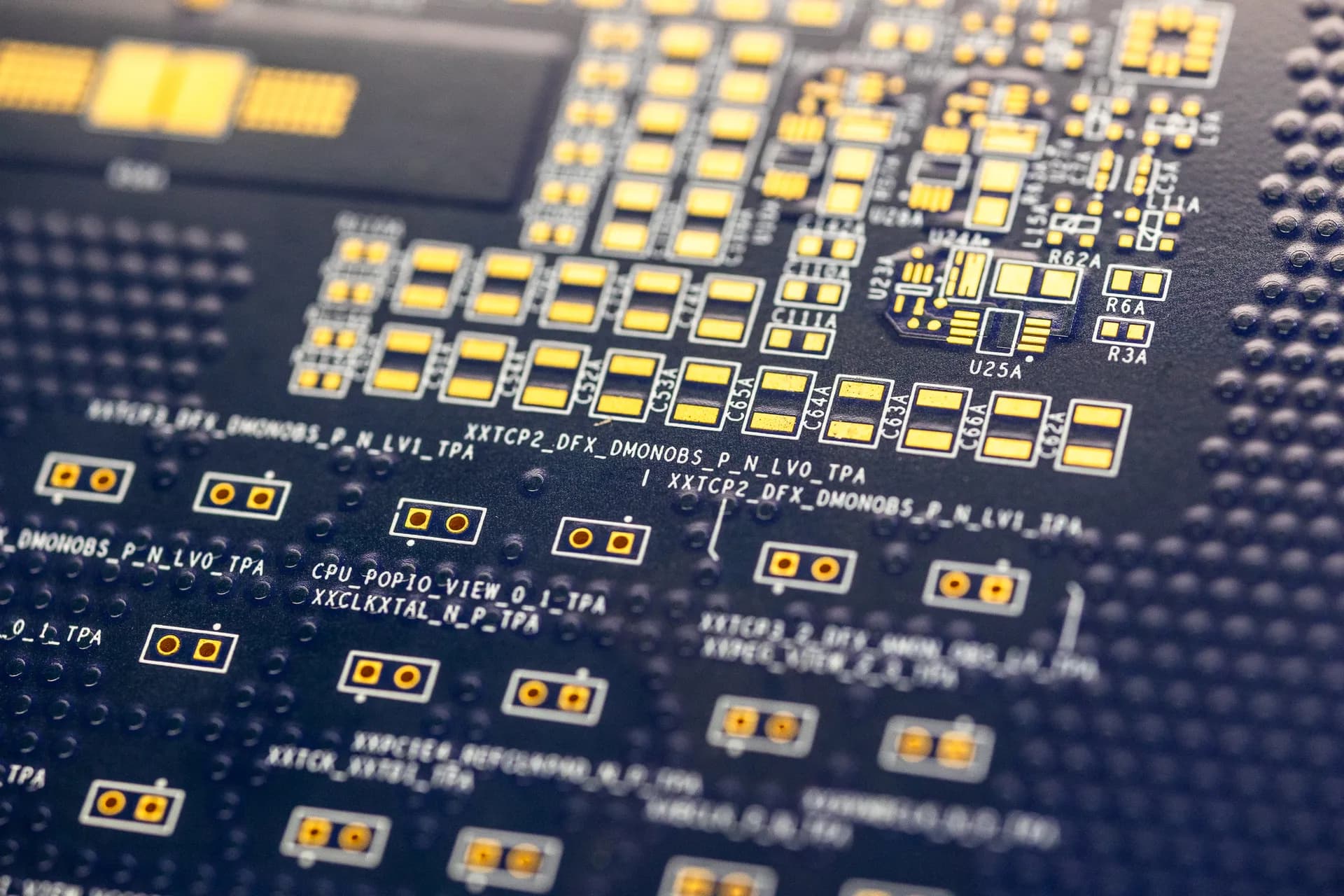
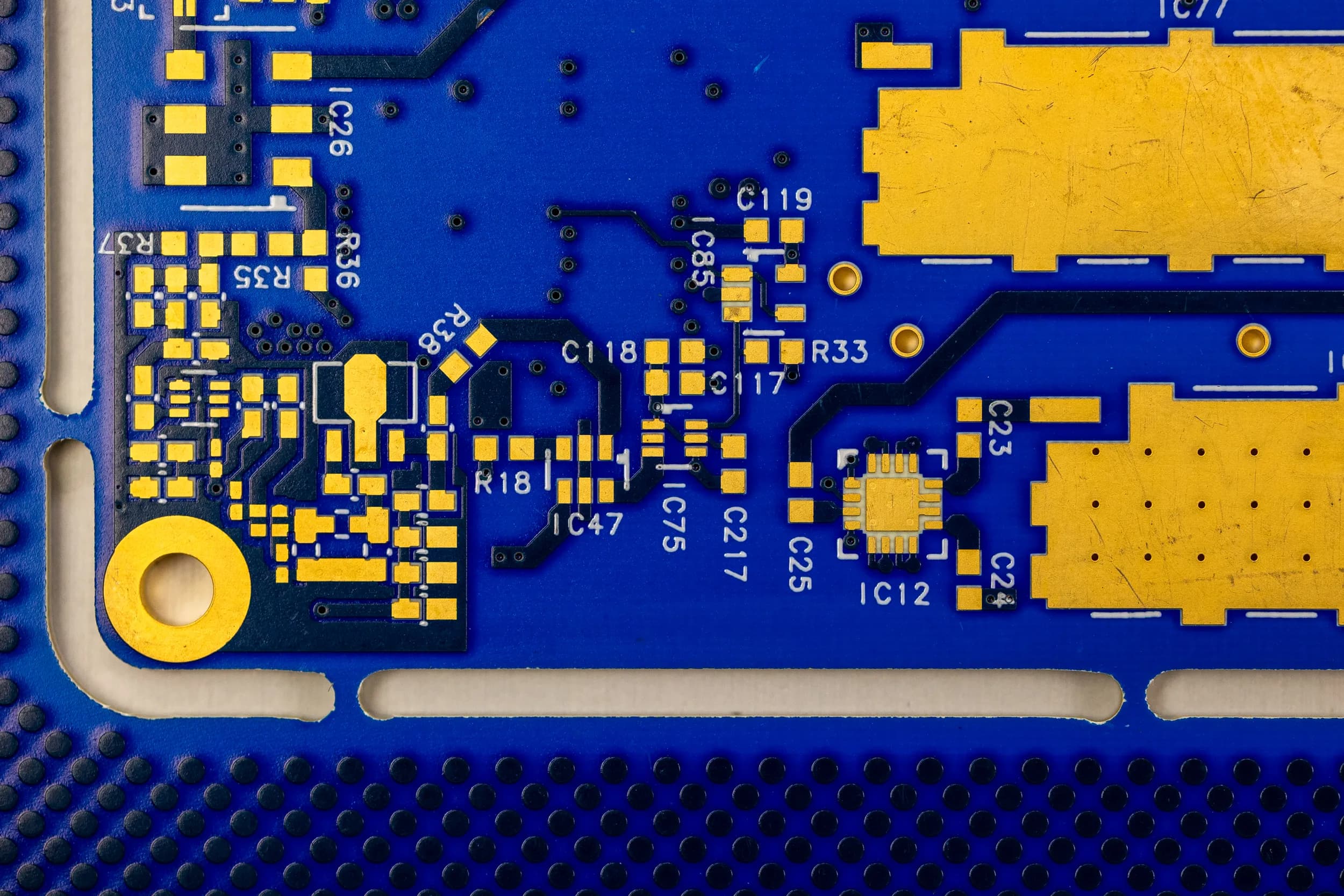
Solder mask clearances and the narrow strips of mask between pads are checked against process limits. Legend text is checked for legibility and clearance from pads. The surface finish is confirmed as suitable for your assembly process and any fine-pitch components.
OUTLINE, PANEL AND DATA
The review checks the board outline, routing and edge clearances, and how the board fits a production panel, which has a direct effect on cost. Finally, it confirms the data set is complete and consistent: that the drawing, drill files and Gerbers agree with each other.
WHAT YOU GET BACK
The output of a PCB DFM review is usually a set of engineering queries (EQs). Each one names an issue, explains why it matters and, where possible, proposes a fix. Some are simple clarifications, such as which of two conflicting notes applies. Others suggest a change that improves yield or reduces cost without affecting performance.
You stay in control of the design. A good manufacturer won't quietly change your data; it will explain the trade-off and let you decide. The quicker those decisions come back, the less time the queries add to your lead time.
WHEN TO ASK FOR A PCB DFM REVIEW
The short answer is earlier than most teams do. There are two points where a review earns its keep.
At the start of layout. Agree the stack-up, materials and impedance structures with your manufacturer before routing begins. Changing a dielectric height at this stage takes minutes. Changing it after layout can mean rerouting every controlled impedance track.
Before you release the files. A final review of the complete data set catches the detailed issues: clearances, drill sizes, mask, finish and documentation gaps. It's also the last cheap moment to make a change.
Some designs benefit from early input more than others. It's worth starting the conversation before layout if your design:
- uses a technology that's new to your team, such as HDI, flex-rigid, RF materials or copper via fill
- has tight impedance targets or a hybrid stack-up
- uses an unusual or long-lead material
- runs to a high layer count or a thick finished board
- sits on a tight new product introduction (NPI) timescale, where a re-spin would hit the launch date
- is moving to a new manufacturer, whose process limits may differ from your last supplier's
If the files have already gone out, a review at quote stage is still far better than none.
There are a few ways in which PCB design decision can affect manufacturing. As such, it's in everyone's best interest to ensure designs are perfect before manufacturing begins.
GETTING THE MOST FROM A REVIEW
A review is only as good as the information behind it. Gerber files show the copper, but they don't tell the manufacturer how to build the board. Alongside them, send:
- drill files, with plated and non-plated holes clearly separated
- a fabrication drawing covering material, board thickness, copper weights and surface finish
- your stack-up, including any controlled impedance targets
- an IPC-D-356 netlist, so electrical test results can be checked against your design intent
- your build requirements: IPC class, quantity and the date you need the boards
The more complete the pack, the fewer queries you'll see, and the more the remaining ones will focus on genuine improvements rather than missing information.
HOW WE APPROACH DFM AT EXCEPTION PCB
At our site, front-end engineering is the first stage every design goes through. Our engineers prepare the manufacturing data, review your design against our process capability and raise queries before production starts, with a clear explanation and a suggested fix wherever we can offer one.
That early conversation matters most on the builds we specialise in: HDI, Flex & Flex-Rigid, RF, advanced materials, copper via fill and resin via fill. On a quick-turn prototype, it's often the difference between first boards that work and a second spin.
If you're working on a design now, ask us for a PCB DFM review before you release it. Find out more about our design for manufacture support or request a quote.
FREQUENTLY ASKED QUESTIONS
WHAT IS THE DIFFERENCE BETWEEN A PCB DFM REVIEW AND A DESIGN RULE CHECK?
A design rule check (DRC) in your layout software tests your design against the rules you've set. A PCB DFM review tests those rules against a specific manufacturer's real process capability, so it can catch issues a clean DRC won't show.
WILL A DFM REVIEW CHANGE MY DESIGN?
Not without your agreement. The review produces engineering queries that explain each issue and suggest a fix. You decide which changes to make.
WHEN SHOULD I ASK FOR A PCB DFM REVIEW?
Ideally twice: once at the start of layout to agree the stack-up, materials and impedance structures, and again before you release the final files. If the files have already gone out, a review at quote stage is still worth having.
WHAT DO I NEED TO SEND FOR A DFM REVIEW?
Send your Gerber files with drill files, a fabrication drawing, your stack-up and impedance targets, an IPC-D-356 netlist, and your build requirements, including IPC class, quantity and delivery date.
WHICH DESIGNS BENEFIT MOST FROM A DFM REVIEW?
Designs using HDI, flex-rigid, RF materials or copper via fill, and those with tight impedance targets, hybrid stack-ups or high layer counts. A review also pays off when you're moving a design to a new manufacturer.
WHAT IS THE DIFFERENCE BETWEEN DFM AND DFA?
DFM covers how the bare board is fabricated. Design for assembly (DFA) covers how components are placed and soldered onto it, and your assembly partner reviews it separately.